Average Reviews:

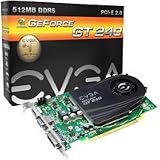
(More customer reviews)If you're not familiar with this card it's essentially a tweaked GT 220; from what I've read, it has more shader units, more textures, and faster memory though a slower clock speed. It's supposed to be somewhere performance wise between the GT 220 and a 9800 GT if that gives you a better idea where it stands in the lineup.
A GT 240 comes in three different varieties. There is a version with 512MB DDR3 memory, a version with 1GB DDR3 memory, and the version you're looking at here with 512MB memory. If you're not familiar with the difference, DDR5 memory is significantly faster. Ignore the 1GB DDR3 model! In nearly all cases, you'll get better performance with 512MB of DDR5 than a whole gig of DDR3. A lot of these cards have a lot of slower memory so they can say they have a lot, but realistically you'll probably never benefit from it. Benchmarks I've seen show the DDR3 versions as significantly inferior. Faster memory = much better performance.
**UPDATE: I've just spotted a 1GB DDR5 version, though it's still debatable if you'll ever use all that. Not worth it to me for the price difference, but it's your call.**
This is important. It is not a PCI card. You NEED a PCI express X16 slot to use this card. The x16 refers to the type of the PCI-E slot that you put the graphics card into. Most graphics cards go into a x16 slot. It gets a little more complicated; this is a PCI-E 2.0 card. The reason this is important, is that most computers made a couple years ago will probably only have a PCI-E x16 1.0 slot. You will get the best performance with a 2.0 slot, however a 2.0 card is FULLY COMPATIBLE with the 1.0 slot; the only difference is the 2.0 slot can accommodate twice the data transfer rate, but with the current cards you'd probably never need that much bandwith so you won't lose much performance if any. I'm using it in a 1.0 slot and it works great. It's also pretty quiet. My case fan is loud anyway so I don't notice it over that.
I've been getting really good performance from this card. I don't have a lot of games that really tax it yet, but it definitely lets me play at a higher resolution with better textures than my previous card, an aging 8400 GS. I really don't need the fastest graphics card out there, I mostly play older games because they're cheaper and I really don't need the fanciest graphics. Actually only got this card because it was such a good deal on the sale I found or I'd still be using the old one. That said, I'm obviously enjoying the greater graphics power and think this card was a good purchase. This is not a blow you away, top-of-the-line, knock your socks off card. It's not intended to be. It's a perfect fit for light gamer who wants to be able to play old games with the graphics turned up and the latest games with some kind of decent frame rate even if he/she needs to turn the graphics settings down a bit in the game. Depending on sales, you might be able to get a 9800 GT which is a more capable card for about the same price, though I think the 9800 GT outputs more heat so balance your needs.
One of the things I really like about this card is power consumption. The maximum drain is something like 70W, which means it doesn't need a separate connector to a power supply. It should also work with the 300W power supply, and I've heard unsubstantiated secondhand claims that it can even managed on a 250W, however I'd suggest running it with at least a 400 W power supply. You almost certainly have more than just this card plugged in and you really don't want to strain the power supply; if the power supply dies it can send a jolt of power that can easily destroy your whole machine. Plus since power supplies have to be a set size, a general rule is the more wattage the power supply can output the more efficient and less heat it produces. Your system USES the same amount of power with a 300W or a 500W, so you're not wasting money on electricity; it's just available capacity which usually translates to cooler and more efficient. Get a good brand though, Antec or somebody else well known; cheap supplies tend to exaggerate their rating.
This is also critical, whatever you do though, MAKE SURE your power supply can handle 18 A on the +12 V rail; if you don't know what that means it's how much power the supply can provide; check your power supply and it should have a sticker or something written on the side that tells you how many amps it can provide. Amazon often doesn't include this information, so you might have to look elsewhere if purchasing. Seriously, it's easily as important as the Watts the supply can output when it comes to video cards. I'm using an Antec BP500U ATX 500W Power Supply in my system, so if all else fails you could just buy that; it's cheap and reliable. If your power supply doesn't have enough amps, at best you starve the card and at worst you blow your power supply and possibly ruin your computer.
One of the other selling points for this card is that it runs cool compared to a lot of other higher powered cards. I've only been using it for a few days but it seems to idle around 37°C and when I was playing a game for a couple hours a got up to about 68°C. That's a lot hotter than my 8400 GS, but then again were talking about a three year younger card with a lot more power. My computer is an HP 8100n which has kind of a small case, so I'm hoping I don't have any difficulties with overheating, fingers crossed. The card comes with some nice software called Precision which the manufacturer includes so you can overclock your card if you'd like, but it's also very helpful to see the temperature of the card. It has a nice feature where you can even have it show you the temperature of the card while you're playing a game. The temperature appears in the upper left-hand corner of the screen so you can monitor if something is getting too hot and you might have to turn off the computer. Other than the CD with that software and the drivers on it, there's not much to the package. The card has one output in DVI and one output in VGA, but does not come with the converter so if you want to use two monitors you either have to buy a converter yourself or hope both monitors have different connectors.
--Update--
I had a little problem with my monitor failing to wake if the computer woke from standby while the monitor was still in standby. However, I think I've tracked it down to an incorrect setup in my BIOS. If you have integrated video (i.e. no video card is installed, but you can still plug a monitor into the computer and get a picture) like a lot of computers have, be sure you change settings in your BIOS after you install this card. Generally it's by hitting Escape, F10, or some other key at system boot. A lot of computers briefly show what button to press when they first start up; it may be called Setup. For mine, I had to change the primary video adapter from PCI (Yes, the integrated video claimed it was PCI for some reason. Go figure.) to PCI-E. Since correcting that, I've had no more wake up issues.
Click Here to see more reviews about: EVGA nVidia GeForce GT 240 512 MB DDR5 VGA/DVI/HDMI PCI-Express Video Card 512-P3-1240-LR


No comments:
Post a Comment